




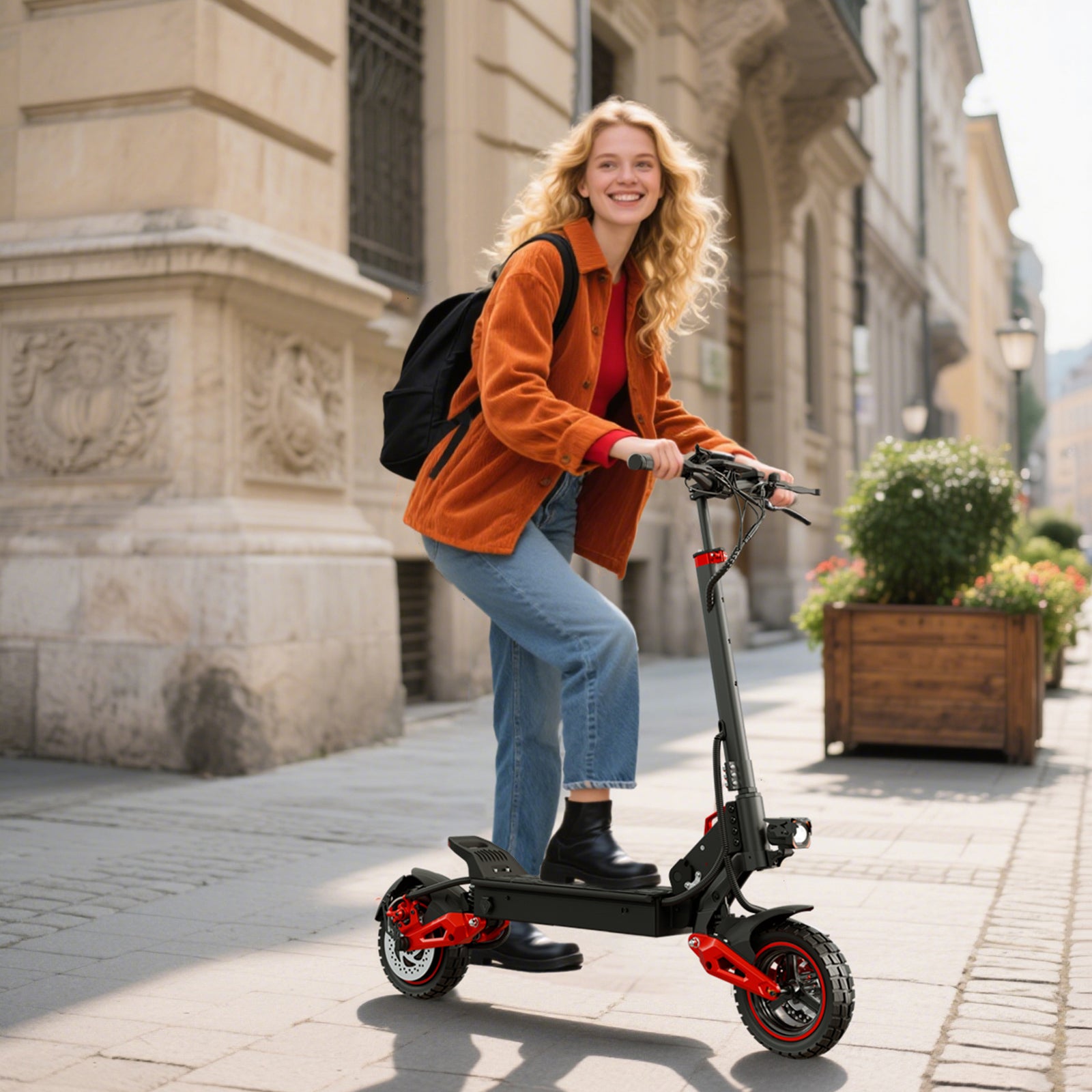
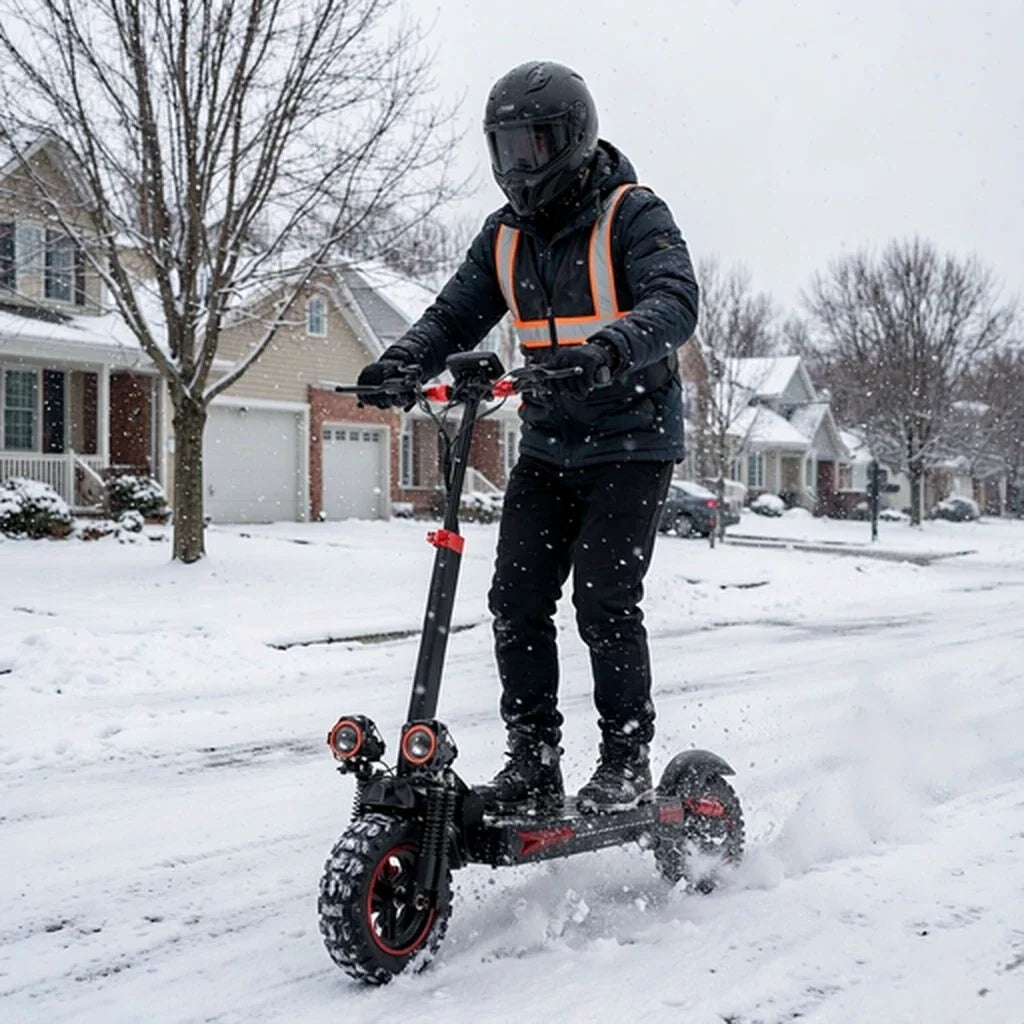
Your electric scooter loses range in winter for two separate reasons, and only one of them is fixable. Cold slows the chemical reaction inside the battery, which is temporary. Capacity comes back when the pack warms up. But charging a frozen pack causes damage that never comes back, so protect it from cold charging and accept some range loss when riding.
01. How Cold Weather Affects Electric Scooters
Cold Slows the Battery, and Range Drops With It
Lithium-ion cells move ions between the anode and cathode, and cold thickens the electrolyte that carries them, so voltage sags under load and the controller reads "low battery" earlier than it should. Expect 10–25% less range in near-freezing conditions before you add lower tire pressure, denser air or heavier clothing; AAA's EV testing found losses from about 12% at 20°F to over 40%.
Tire Pressure and Grip
Pneumatic tires lose pressure in cold even without a leak, at roughly 1 psi per 10°F. A tire reading 50 psi in September reads 42 psi in January. Under-inflation raises rolling resistance and changes the contact patch, and the rubber compound hardens below about 40°F.
Moisture, Rain and IP Ratings
The risk isn't the splash but water that stays in a connector or the deck seam and freezes, since ice expansion pries seals open. IPX4 handles splashes, IPX5 handles directed jets, and neither means submersible. FREEBOY's H14 is IPX4, while the J11 series is IPX5.
02. Electric Scooter Battery Care in Winter
This is the section that saves you money. Everything else here is maintenance.
Never Charge Below 32°F
Most packs are happiest between 50°F and 77°F (10–25°C). Room temperature, not a freezing garage. Below 32°F (0°C), do not charge at all: a cold cell forces lithium ions onto the anode as metallic lithium instead of letting them intercalate, and that plating is permanent. University of Alaska Fairbanks research found a single 1C charge at 0°C caused about 3.6% irreversible capacity loss, while repeated 0.5C charging at −10°C cost 25% of capacity in 40 cycles.
Let It Sit 1–2 Hours Before Plugging In
If the scooter has been outside in freezing weather, bring it in and wait 1–2 hours so condensation can evaporate off the charge port. Use the original charger, skip the overnight charge on a cold concrete floor, and never charge in a sealed closet.
Monitor Range: 10–25% Is Normal, 40% Is Not
Note your October range and compare in January. A drop within 10–25% is normal cold behavior, while 40% or more, or a pack that won't hold charge once warm, points to real degradation.
Warranty note: FREEBOY covers frame, motor and controller for one year, but the battery and charger for six months. Replacements ship separately from the parts collection.

03. How to Store an Electric Scooter in Winter
Pick a Dry Space, Clean It, Store at 50–70%
A basement corner or interior closet beats a garage every time, since garages sit below freezing for weeks; avoid anywhere near a furnace, because sustained heat ages a pack as fast as cold damages it. Rinse the deck with a damp cloth. Never use a hose or pressure washer. Dry the charge port, then set the pack to 50–70%: full accelerates cathode degradation, near-empty risks over-discharge.
Check Every 30–45 Days
Top the pack back to 50–70% every 30–45 days to replace self-discharge and keep it out of over-discharge. Set a phone reminder, because this is the most-skipped step and the one that kills the most batteries.
04. Winter Maintenance for Tires, Brakes and Suspension
Check Tire Pressure Weekly, Brakes Before Every Ride
Use a gauge, not a thumb press, and inflate to the sidewall spec after the first cold snap. Then clean the rotor with isopropyl alcohol, check pad thickness, and adjust the cable if the lever pulls nearly to the grip. Cold rubber hardens, so a summer tire will slide on a 35°F wet road.
Check Suspension and Fasteners
Compress the suspension by hand and listen for grinding: a harsh fork in January is normal, metal-on-metal noise is not. Go around the stem, folding mechanism, calipers and axles with a hex key, because stem play is the most common winter failure.
05. Safe Electric Scooter Riding Tips for Winter
Slow Down and Brake Earlier
Cut your normal speed by about a third when wet, since painted markings get slick and metal plates, manhole covers and bridge joints are actively dangerous when damp. Stopping distance can roughly double, so increase your following gap and brake progressively with both brakes.
Avoid Ice and Heavy Snow
Don't ride on ice. Not slowly, not carefully, just don't. Watch for temperatures hovering around 32°F, when wet patches refreeze into black ice you can't see until you're on it, and deep snow will stop a 10-inch wheel outright.
06. Common Electric Scooter Winter Maintenance Mistakes
Charging While Still Cold
The single most expensive mistake. Riders come home, plug in while the pack is still frozen, and repeat it all winter. Let it warm up first, every time.
Deep Water, Snow and Outdoor Storage
IPX4 and IPX5 protect against splashes and jets, not immersion. A puddle deep enough to reach the deck can flood the battery compartment, and warranties exclude submersion damage. A covered porch is still outdoors, and freeze-thaw cycles work moisture into every seal.
07. Winter Electric Scooter Maintenance Checklist
Use this checklist to keep track of the most important winter maintenance tasks.
| Check | Frequency | What to Look For |
|---|---|---|
| Battery condition & charge level | Before each ride | Level drops, swelling, unusual warmth |
| Tire pressure | Weekly | 1 psi loss per 10°F drop |
| Brakes | Before each ride | Lever travel, pad thickness, rotor grit |
| Lights and signals | Before each ride | Dead LEDs, cracked housings |
| Bolts and connections | Monthly | Stem play, loose calipers, frayed cables |
| Cleaning | After wet rides | Salt, grit, moisture at charge port |
| Storage top-up | Every 30–45 days | Keep pack at 50–70% |
Intervals are general guidance. Your model's manual is the authority.
08. Final Thoughts: Keep Your Electric Scooter Ready for Winter
Winter doesn't kill scooters. Cold charging does, and so does parking one in a freezing garage for four months at full charge. Get three habits right. Never charge below freezing, store at 50–70%, and check tire pressure weekly. These steps help reduce the risk of common winter battery and maintenance problems.
If you're buying a scooter to ride year-round, the IP rating and the tire matter more than top speed.
The 600W H14 runs 22 mph and 22 miles on 14-inch pneumatic tires with dual disc brakes and IPX4. Those larger wheels handle cold-weather cracks and patched asphalt differently from the 10-inch tires found on many scooters at this price, and it's the cheapest route into dual discs.
The J11 PLUS adds IPX5 and 11-inch off-road tires for steady rain or unpaved shortcuts, with 35 mph and up to 37 miles of range.
Neither is built for snow or standing water, and batteries, chargers and brake pads ship separately. This matters most in February, when a dead charger shouldn't sideline the scooter until spring.
Looking for an electric scooter for your next ride?
Compare the FREEBOY H14 and J11 PLUS to find the features that fit your riding needs.

09. Frequently Asked Questions About Electric Scooter Winter Maintenance
Does cold weather damage electric scooter batteries?
Cold storage is mostly reversible. Capacity returns once warm. Cold charging is what causes permanent damage, by plating metallic lithium on the anode. Never charge below 32°F.
How much range does an electric scooter lose in winter?
Typically 10–25% at near-freezing temperatures, more with hills, headwind or a heavier rider. Above 40%, or a loss that doesn't recover once warm, suggests real degradation.
Is it safe to charge an electric scooter in cold weather?
Not below freezing. Bring it indoors, let it reach room temperature for 1–2 hours, and check the charge port is dry first.
Should I store my electric scooter fully charged?
No. Store at 50–70% and top it back up every 30–45 days. Full charge accelerates capacity loss; near-empty risks over-discharge.
Can electric scooters be used in snow?
Light snow is rideable at low speed on models with adequate IP ratings and pneumatic tires. Ice is not, and deep snow risks water intrusion most warranties exclude.
Share:
Why Choose FREEBOY Electric Scooters?