


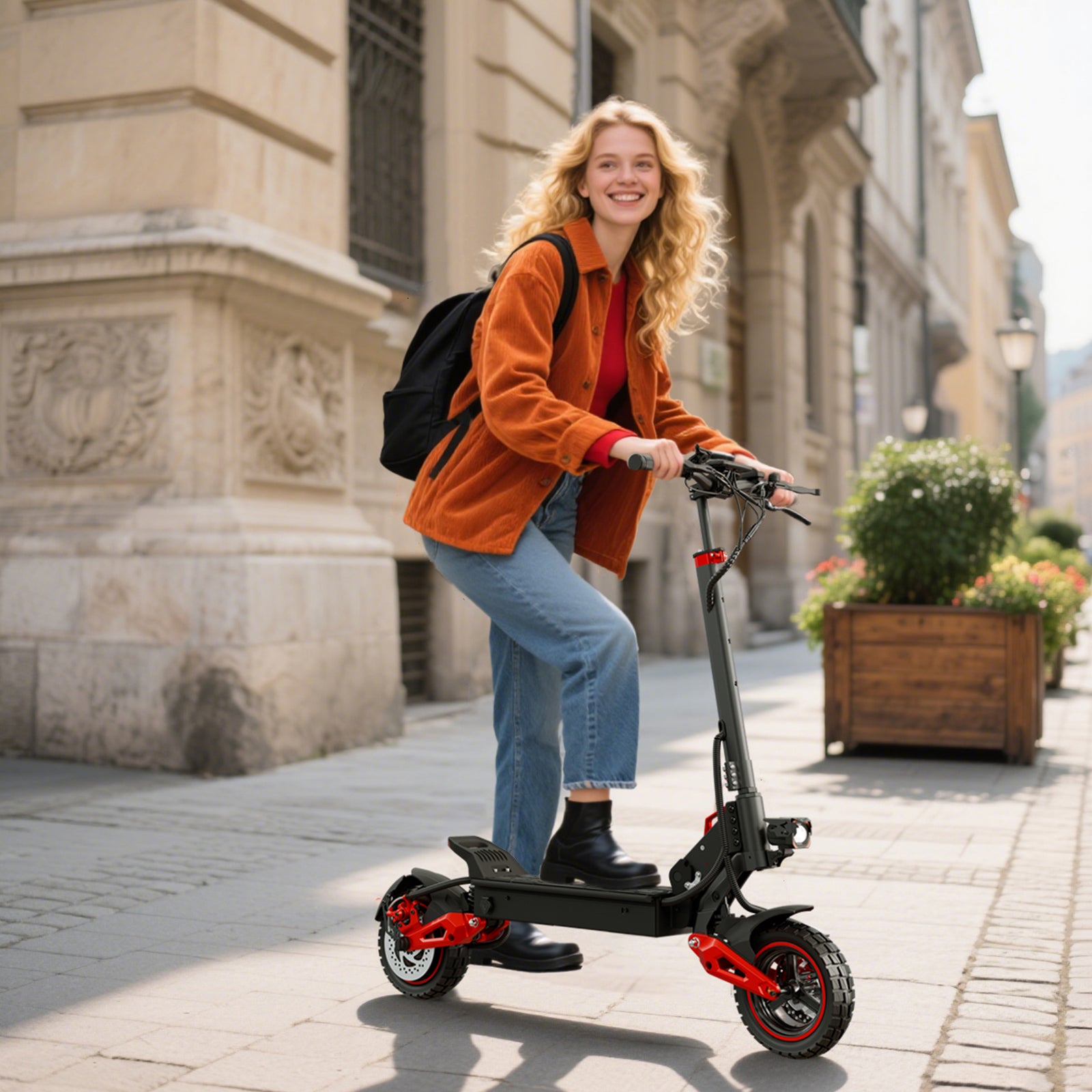
Going to school by electric ride can make a daily commute more convenient and enjoyable. For students who live a few miles from school, an e-scooter or e-bike can provide an alternative to being driven every day.
But choosing between an electric scooter and an electric bike is not simply about which one is faster. The right choice depends on the student's age, riding experience, commute distance, road conditions, comfort, storage needs, and budget.
For parents, safety and control are especially important. For students, convenience and riding experience may matter just as much.
So instead of asking which one is better overall, it makes more sense to ask which one is better for the student's daily routine.
What Should Students Consider Before Choosing?
Before choosing an electric scooter or e-bike for school, think about what the daily ride actually looks like.
The distance between home and school is one of the most important factors. A short trip through a neighborhood has very different requirements from a 10-mile commute.
The route matters, too. Smooth city streets, hills, uneven pavement, gravel paths, and bike trails can all require different types of vehicles.
Comfort should also be considered. A student riding for 10 minutes may have very different needs from someone spending 30 minutes or more on the road every day.
Finally, consider storage and portability. An electric scooter is generally easier to store and move around, while an e-bike provides a seated riding position that can be more comfortable for longer trips.

E-Scooter vs E-Bike: What Is the Difference?
The biggest difference is how you ride them.
An e-scooter is ridden standing up and is generally designed around compact urban mobility. It can be convenient for short trips, quick stops, and situations where easy storage is important.
An e-bike is ridden more like a traditional bicycle. The seated position can make longer journeys more comfortable, while larger tires and suspension on some models can make the bike more suitable for uneven roads and outdoor riding.
Neither option is automatically better. The better choice depends on the student's route and how they plan to use the vehicle.
| Feature | E-Scooter | E-Bike |
|---|---|---|
| Riding position | Standing | Seated |
| Short city trips | Excellent | Good |
| Longer rides | Good | Excellent |
| Portability | Usually easier | Usually less convenient |
| Rough terrain | Depends on model | Generally more capable |
| Storage | More compact | Requires more space |
| After-school riding | Good | Excellent |
| Best for | Short urban commuting | Longer & more varied riding |
When Does an E-Scooter Make More Sense?
An e-scooter can be a practical choice when the school is relatively close and the route is mostly paved.
Students can easily get on and off, maneuver through urban environments, and store the scooter when they arrive home. For a short daily commute, these advantages can make an e-scooter extremely convenient.

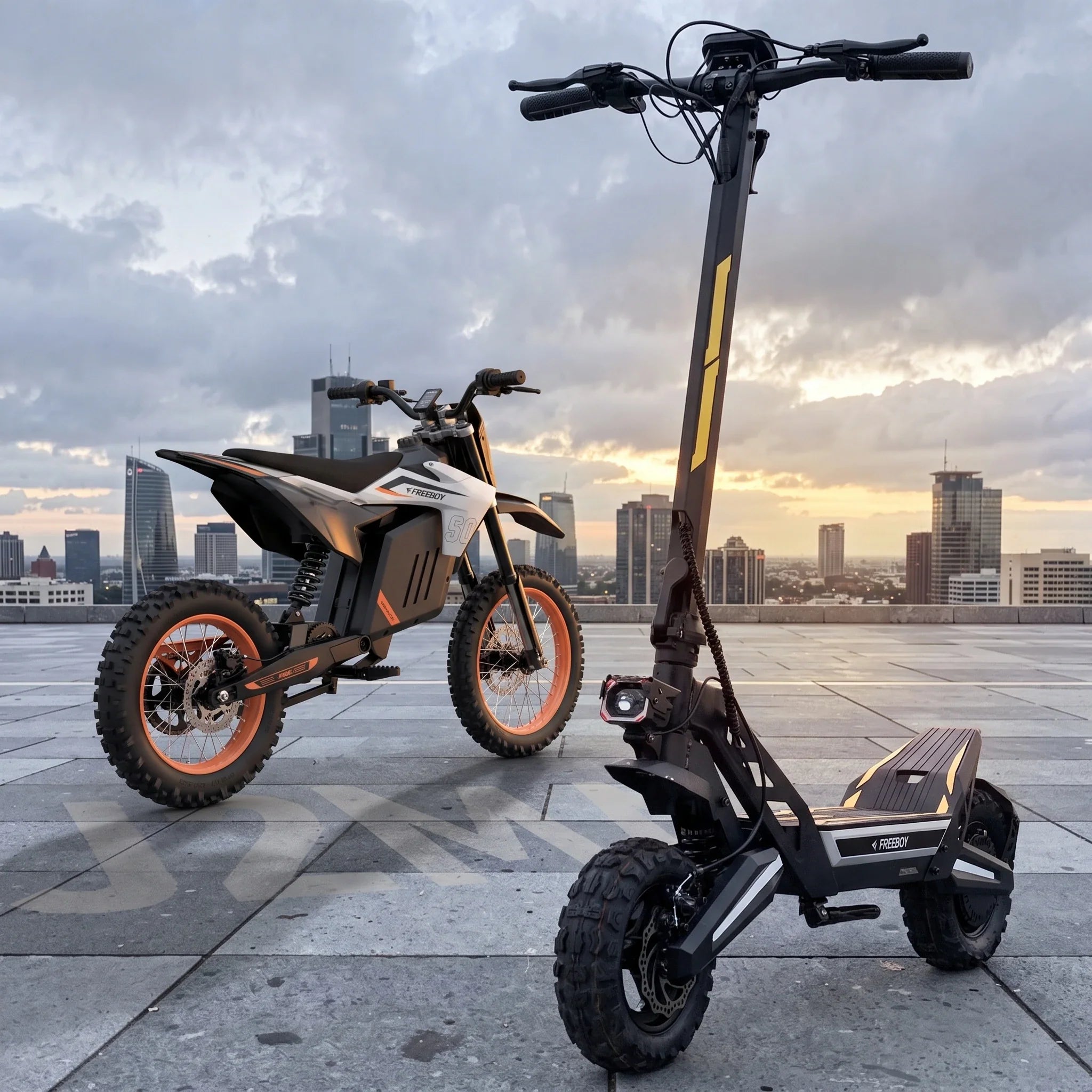
The FREEBOY J2 is designed for everyday commuting and light exploration. It combines a 1200W motor, up to 31 miles of range, 11-inch off-road vacuum tires, front and rear suspension, and dual disc brakes.
Its high-carbon steel frame and wide, extended deck provide a solid and comfortable riding platform, while the thumb throttle makes acceleration easier to control.
The J2 is a practical option for riders who want an e-scooter that can handle everyday commuting while still being ready for light recreational riding.
When Does an E-Bike Make More Sense?
An e-bike can be a better choice when the commute is longer or includes hills and uneven surfaces.
The seated riding position can make longer journeys more comfortable, while a larger frame, suspension, and off-road tires can provide additional stability on more demanding routes.
An e-bike can also be used beyond school. Students can use it for neighborhood rides, weekend trips, and outdoor adventures.

The FREEBOY Y88 is designed for younger riders who want more performance from an e-bike. It features a 3000W mid-drive motor, a 48V 30Ah battery, up to 31 miles of range, and a top speed of 31 mph.
Its dual suspension, professional off-road tires, and dual disc brakes help make it suitable for varied terrain, while the mid-drive motor provides strong climbing performance. The Y88 is designed with younger riders in mind who have suitable riding experience and want an e-bike for both commuting and outdoor riding.
Because the Y88 offers considerably more power, parents should consider the rider's age, physical ability, experience, and local regulations before choosing this type of higher-performance e-bike.
What About Comfort and Stability?
Comfort becomes increasingly important as riding time increases.
For e-scooters, the deck, suspension, tires, and riding position all affect comfort. The FREEBOY J2's wider and longer deck gives riders more room to adjust their stance, while its dual suspension helps absorb vibration from uneven roads.
For e-bikes, the seat, frame, tires, and suspension play a larger role. The Y88 combines dual suspension with professional off-road tires to provide a more controlled ride on varied surfaces.
If a student only rides for a few minutes each way, portability may matter more than maximum comfort. For longer commutes, however, riding comfort becomes much more important.
Which One Is Better for Different School Routes?
Looking at the actual route can make the decision much easier.
| Your School Commute | Better Choice | Why |
|---|---|---|
| Short and mostly flat | E-Scooter | Compact and convenient |
| Short but with rough pavement | E-Scooter or E-Bike | Depends on comfort needs |
| Longer daily commute | E-Bike | Seated riding is more comfortable |
| Lots of hills | E-Bike | Better suited to climbing |
| Mostly city streets | E-Scooter | Easy to maneuver |
| Mixed roads and trails | E-Bike | More versatile |
| School + weekend riding | E-Bike | More recreational versatility |
| Limited storage space | E-Scooter | More compact |
This is why there is no single answer for every student. The same e-bike that is perfect for one student may be unnecessary for another.
Safety Matters More Than Speed
For students and parents, safety should always come before performance.
A properly fitted helmet should be worn on every ride. Students should also learn how to brake smoothly, make controlled turns, and respond to unexpected situations before riding in traffic or unfamiliar areas.
Visibility is another important consideration, especially for students who ride early in the morning or later in the afternoon.
Parents should also check local laws before allowing a child or teenager to ride an electric scooter or e-bike to school. Rules regarding minimum age, speed limits, helmets, bike lanes, sidewalks, and where electric vehicles can be used vary by location.
Most importantly, a higher top speed does not automatically make a vehicle a better choice.
The rider needs to be able to control the vehicle confidently and responsibly.

How Should Parents Choose?
When choosing an electric scooter or e-bike for a student, start with five simple questions.
| Question | Why It Matters |
|---|---|
| How far is the school? | Determines range and comfort needs |
| What does the route look like? | Helps determine tire, suspension, and power requirements |
| How experienced is the rider? | Determines what level of performance is appropriate |
| Where will the vehicle be stored? | Affects portability and size |
| What is the budget? | Helps narrow down realistic options |
For a short, mostly paved commute where convenience and compactness are priorities, an e-scooter such as the FREEBOY J2 may be the better fit.
For longer rides, hills, varied terrain, and students who want to combine commuting with outdoor riding, an e-bike such as the FREEBOY Y88 may be more suitable.
The goal is not to find the fastest or most powerful vehicle. It is to find one that fits the student's actual needs.
Final Thoughts
An e-scooter and an e-bike can both be useful for school commuting, but they offer different riding experiences.
An e-scooter is a strong option for students who prioritize convenience, maneuverability, and short-distance urban travel. An e-bike can be a better choice for longer rides, varied terrain, and students who want to use the same vehicle for commuting and outdoor adventures.
The FREEBOY J2 focuses on everyday commuting and light exploration, while the FREEBOY Y88 offers stronger performance and off-road capability for more experienced young riders.
Ultimately, the right choice comes down to the student's age, experience, commute distance, riding environment, storage needs, and budget. Choose based on how the vehicle will actually be used—and always put safety first.
Share:
How to Keep Kids Safe on Electric Bikes This Summer
Electric Scooter Laws in the US: What Riders Need to Know